The nuclear strong force behaves in a way consistent with the model of particles presented on this…

Two Angstrom Towards the Blue End
We can calculate the blueshift of deuterium relative to hydrogen from standard theory, and we can confirm this with laboratory experiments. In both cases, we get that the light spectrum of deuterium has a blueshift of 2 angstrom relative to hydrogen.
Deuterium blueshift
Note that the only difference between deuterium and hydrogen is that deuterium is twice as massive as hydrogen due to a neutron attached to its atomic nucleus. There’s no electric or chemical difference between the two.
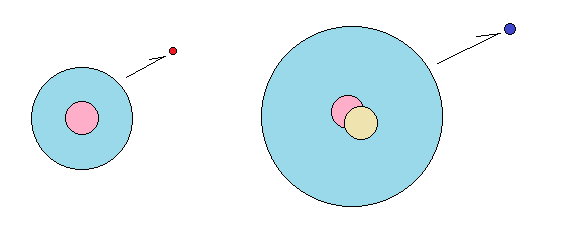
Heavy isotopes emit bluer light than lighter ones
This means that the blueshift of deuterium depends solely on the mass of the nucleus.
The bouncing electron
Assuming that isotopes of all gasses display a similar blueshift, we can conclude that the energy levels of electron orbits are largely determined by the size of their respective atomic nuclei. This in turn lends support to the bouncing electron model where this is the case.
A bigger nucleus will act as a bigger trampoline for the electrons, leading to more energetic bounces despite the fact that the charges involved are unchanged.

Related Posts



Comments (0)